
Publication and extensions / Google Scholar
Help readers find the paper, not just the conference.
Leconfe publishes each proceedings paper with citation metadata in a format Google Scholar recognizes. The demo paper meets Scholar’s core metadata requirements: the paper title, a separate entry for each author, and the publication date.
Leconfe proceedings in Google Scholar
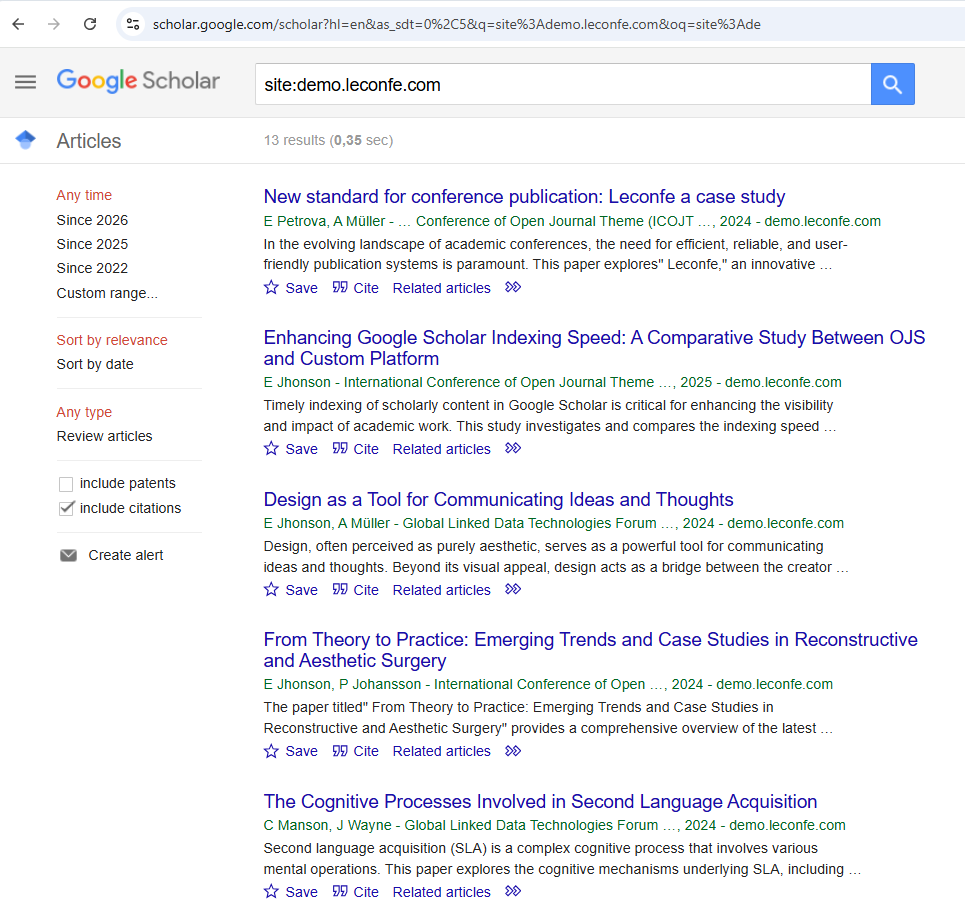
Review a paper as a reader would.
The demo paper also identifies its conference, volume, issue, page range and PDF in machine-readable fields. When you publish your own proceedings, check that those details match what readers see.
Start at the proceedings
Follow a normal link from the volume to a dedicated page for one paper. A single PDF containing the entire conference is not a substitute for individual article pages.
Check the citation details
Match the title, author order and publication date against the final paper. Conference-level keywords do not replace paper-level bibliographic metadata.
Open it while signed out
The complete author-written abstract or full text should be easy to read without signing in. If you offer a PDF, check that its text is searchable.
Published, discoverable, indexed: three different things.
Leconfe helps present the publication record. Meeting the metadata requirements helps Scholar identify a paper. Google Scholar still decides whether and when to index it.
Can a reader reach the paper?
Open the proceedings in a private window and follow the paper title. Check that the destination is the article itself, not a login page or a file picker.
Can a crawler identify the work?
Compare the paper page’s citation metadata with the visible title, authors and date. If they disagree, review the publication record and your site configuration.
Why is a new paper missing from results?
Check access and metadata first, then search for its exact title. Publication or DOI registration does not guarantee inclusion, ranking or a particular indexing date.